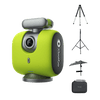


XbotGo Falcon

How to Build a Basketball Training Program That Actually Works
Most players train hard. Very few get better. That’s not a motivation problem — it’s a structure problem. A good basketball training program looks different from most gym workouts, and the difference comes down to design, not effort. This guide breaks down exactly how to build one that actually transfers to games.
Build Your Week Before You Hit the Gym
Training three to five days per week is the right target for most players. Fewer than three makes it hard to build momentum. More than five without adequate recovery stalls progress and raises injury risk.

The key is intensity variation. Not every session should push you to the limit. Hard days and light days need to alternate — and your gym work should mirror your court work. If Monday is an intense skill session, make it an intense lifting day too. If Tuesday is lighter on-court work, keep the weight room session light as well. The body adapts when stress and recovery work in rhythm.
A workable weekly structure:
- Monday / Wednesday — High-intensity skill work + compound lifting
- Tuesday / Thursday — Light skill sessions: ball handling, touch, form shooting
- Friday — Flex day: go hard if the body allows, lighter if not
- Saturday — Optional open gym or pickup
- Sunday — Full rest
Focus Each Session on One or Two Skills

Trying to work on everything in one session is one of the most common reasons players plateau. Pick one or two specific weaknesses and go deep.
Start shooting sessions close to the basket — five feet out — with only your shooting hand. Get the mechanics clean before adding distance. From there, track makes, not attempts. A goal of 250 made shots per session is a solid benchmark for guards and wings. Add pressure by setting targets: make 7 of 10 before moving to the next spot. That friction replicates what games actually feel like.
For solo ball handling, comfort means the drill is too easy. If every rep feels clean, the drill stopped producing adaptation weeks ago. Change directions, vary speeds, add footwork patterns, and move. The best basketball training drills are the ones that force problem-solving, not just repetition.
Get Stronger the Right Way

Strength work matters, but it needs to be basketball strength — not bodybuilder bulk. Two to three sessions per week in the off-season is enough. The exercises that actually move the needle are compound lower-body movements: squats, deadlifts, lunges, and power cleans.
A 2025 complex training study found that combining heavy strength sets with biomechanically similar explosive work produced significant improvements in vertical jump and change-of-direction speed in basketball players. The structure is simple: a heavy squat set followed immediately by box jumps, or a deadlift set followed by depth jumps.
Isolated chest and arm work doesn’t translate to the court. Heavy compound lifts that build lower-body power do.
Play Live — Drills Can’t Teach You Reads
Solo drills build individual skills. They don’t build basketball IQ.
Defensive reads, help rotations, off-ball movement, and timing all come from live play. Pickup games — even 3-on-3 — train the reactive, pressure-filled situations no drill can replicate. A 2024 functional training review confirmed that basketball-specific skills like shooting accuracy and decision-making improve most reliably when training includes game-like conditions.
If your basketball skill development in the gym looks clean but falls apart in games, this is almost certainly the gap. Aim for live play at least twice a week. It doesn’t need to be organized — a park game or open gym counts.
Record Your Sessions and Watch the Footage

Here’s a habit almost nobody uses and almost every expert recommends: record yourself.
Most players have significant mechanical blind spots they can’t feel. A shooting release that drifts left. A weak-hand dribble that telegraphs the move. Footwork that breaks down when tired. These show up clearly on camera and are nearly invisible without it. Watch 10 to 20 minutes of footage after a session, then compare it to a player at a higher level doing the same move. The gap becomes obvious fast.
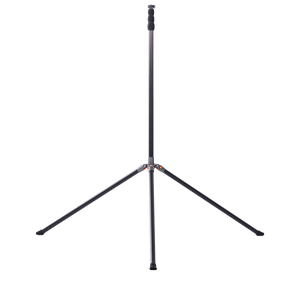
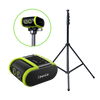
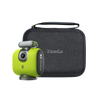
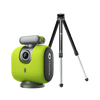
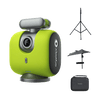
The XbotGo Falcon makes this straightforward. It’s a standalone 4K AI camera that sets up in about two minutes and tracks you automatically — no phone needed, no one to hold it. Set it up at the edge of the court, run your session, then review the footage. One player discovered his off-hand was consistently turning inward on pull-up jumpers — something he’d never caught in years of practice. Two weeks of focused correction fixed it. If you want a hands-free way to record training and build a real record of your basketball progress, it’s worth a look.
Three Mistakes That Keep Players Stuck
Doing the same two drills every session. If your workout looks identical day after day, your body adapted weeks ago. Rotate drill variations, change spots, add pressure constraints.
Practicing at gym speed instead of game speed. Easy reps feel productive. They aren’t. Skills only transfer when trained at the pace and difficulty level of real competition.
Skipping the review. Whether it’s watching footage, doing a quick weekly self-assessment, or just writing down what felt off, the players who improve fastest are the ones who regularly check what’s working and what isn’t.
Put It Together
A basketball training program that works isn’t complicated — but it has to be intentional. Structure your week around intensity waves, focus each session on one or two skills, lift for court-specific power, play live twice a week, and review your work. The players who improve aren’t always training more hours. They’re training with more awareness.