

- Soccer
7 Best Soccer Cameras for Recording Games (2026)
Your child scores the game-winning goal while you're wrestling with your camera, trying to zoom and track the action. By the time you find them in the viewfinder, the ...
The beautifully crafted pass or the surprising goal are the moments of every handball. The moment you miss such moments with your camera, they're gone.
With handball being fast-paced and filled with action, the camera you use should reflect that exactly, one that tracks smoothly, records images clearly, and captures the action that you sometimes blink and miss.
In this blog, we have carefully identified the best cameras for handball. Each listed below has something to offer the handball community, starting with AI-powered auto-tracking cameras to venue-installed club systems and high-performing mirrorless cameras.
We have expanded this guide for 2026 with the systems handball coaches and clubs actually bring up most often, including the panoramic and arena-installed platforms that dominate European handball. Now, let's dive into the best handball cameras on the market.

Handball is not soccer with a smaller field, and the filming problem is genuinely different. Before comparing models, it helps to know the four constraints every handball camera runs into.
A 40 x 20 m indoor court, end to end. A handball court is compact enough that one well-placed camera can cover it, but the ball travels the full length in seconds. A system that pans too slowly will spend the fast break looking at empty floor.
Sports-hall lighting. Most club handball is played under mixed fluorescent or LED lighting that is far dimmer than daylight. This is the single biggest reason footage disappoints, and it is why sensor quality and low-light handling matter more indoors than they do for outdoor sports.
Bodies in the way. Handball crowds sit close to the sideline. Filming from floor level means you spend the game looking at the backs of substitutes, so mounting height is not a nice-to-have.
Who is actually operating it. A parent wants to watch the game, not film it. A coach wants tactical width to see the 6 m and 9 m line setup. A club wants every game filmed the same way without chasing down a volunteer each weekend. These pull toward different products, which is why the list below is grouped by that question rather than ranked as one flat leaderboard.

If you want to see how tracking logic is tuned specifically for the indoor game, XbotGo's handball camera page breaks down court awareness, pose estimation, and fast-break smoothing for the 40 x 20 m court.
| Camera | Type | Needs an operator? | Best for |
|---|---|---|---|
| XbotGo Falcon | Standalone AI auto-tracking | No | Coaches and clubs who want one camera that films every game unattended |
| XbotGo Chameleon | Phone-powered AI mount | No | Parents and teams who already own a recent flagship phone |
| Veo Cam 3 | Panoramic AI, portable | No | Clubs that want the widely used panoramic workflow |
| Pixellot Air NXT | Panoramic AI, portable | No | Clubs and schools that want automated highlights |
| PIX4TEAM 2 | Robot mount for your own camera | No | Anyone who already owns a camcorder or phone worth using |
| Spiideo | Arena-installed multi-camera | No | Arenas, leagues, and federations |
| Hudl Focus | Venue-mounted AI camera | No | Programs already running on the Hudl platform |
| Fujifilm X-H2S | Mirrorless | Yes | Sharp stills and slow motion from the sideline |
| Panasonic Lumix DC-G9 | Mirrorless | Yes | Burst stills of jump shots and saves |
| Sony a6000 | Mirrorless | Yes | Beginners on a tight budget |
| Insta360 X5 | 360 action camera | Partly | Reframing whatever you missed, after the game |
These are the systems you buy once, put on a tripod at the sideline, and leave alone. For most handball parents, coaches, and small clubs, the right answer is somewhere in this group.

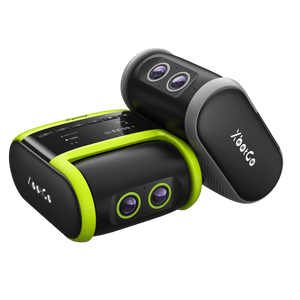
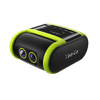
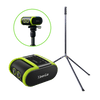
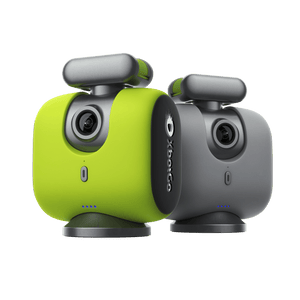
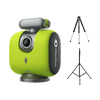
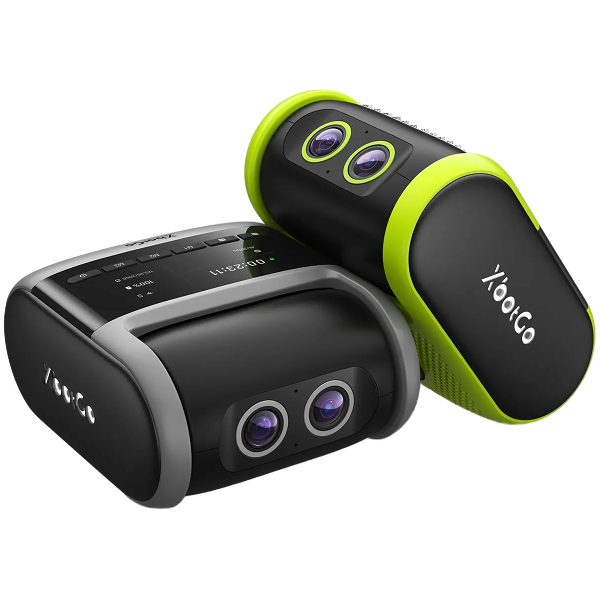
The Falcon is XbotGo's all-in-one 4K AI sports camera, and it is the handball pick because it removes both the cameraman and the phone: power it on, choose the sport mode, and it films.
The tracking is tuned for the indoor game. XbotGo describes the handball logic as court awareness optimized for the 40 x 20 m court, keeping the camera on the 9 m line action rather than the crowd, with pose estimation that locks onto patterns such as the jump shot. Its dual-camera system sees the whole court and the players at once, recording native 4K at 30fps with no cropping, or 1080p at 60fps for slow motion. The battery runs roughly 240 minutes, and Handball Club de Leon is listed among XbotGo's clubs.
Pros
Cons

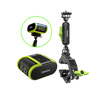
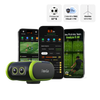
If you want to capture fast-paced handball action without hiring a full crew and you already own a recent iPhone or Samsung, the Chameleon is the lower-commitment way in. It turns the phone you already carry into an AI-tracked sports camera: the phone supplies the lens and the recording, while the Chameleon supplies the AI co-processor and the motorized rotation that keeps the play in frame.
Mount it and let it follow the game. The ScoreSync live scoreboard overlay burns the running score into the footage, an 8-hour working duration covers a match day or several training sessions, and free live streaming plus 20 GB of cloud storage make highlights easy to share. Two things to plan around: your video quality is your phone's video quality, and 4K recording is available in team-sports modes only.
Pros
Cons

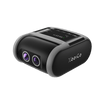
Veo is the name that comes up most often when coaches compare notes online, and Veo markets handball directly, listing it among the sports the Cam 3 supports. It works differently from a pan-tilt camera: it records a fixed 180° view of the playing area for the whole session and then uses AI to move a virtual camera around inside that recording, so the "camera" never physically misses a fast break because it captured everything at once.
Veo lists a battery of up to 6.5 hours, and the camera weighs about 1,250 g. Live streaming is supported. The trade-off is the model: Veo is sold as a camera plus an ongoing subscription to its platform, so the cost keeps running for as long as you use it, and the panoramic approach spreads resolution across the whole court rather than concentrating it on the ball.
Pros
Cons

If a fully automated filming system is what you are looking for, the Pixellot Air NXT is a strong option. This AI camera, built specifically for sports, tracks the action, uploads, and posts content without a camera operator, which is the reason a lot of clubs like it.
It is a portable system that mounts on a tripod, so you can record a full-court game with minimal preparation. The standout feature is that it automatically tracks play and produces highlights on the go, so nobody has to follow the ball or spend hours cutting long recordings afterwards. It suits sports clubs, community schools, and teams that want broadcast-quality video without the expense of a full video crew.
Pros
Cons
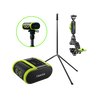
The PIX4TEAM 2 solves a different problem: instead of selling you a camera, it sells you the robot that aims the camera you already own. As the photo above shows, the unit will carry a camcorder or a phone equally happily, and it physically pans to follow the play.
Place it on a tripod or mount it securely, and it takes charge of framing the action in real time. It works indoors and outdoors, which covers both training sessions and competitive matches, and it supports multiple sports rather than handball alone. You can livestream or record and review later, and multiple units can be run together.
Pros
Cons

These are not products you carry in a bag. They are fitted to the hall and then film everything that happens in it. If your club owns or shares a permanent venue and wants every game and every training session recorded without anyone touching a camera, this is the category to look at.
Spiideo is the most handball-native platform on this list. It installs 4K cameras permanently in the arena and uses its AutoFollow technology to produce panoramic capture and automated video for both games and practice, which means recording is simply always available rather than something someone has to remember to set up.
For handball specifically, Spiideo also offers AutoData, a statistics layer generated from the video itself, and it names Elverum Handball among the clubs using it. The federation-level footprint is real too: the Icelandic Handball Association is a published Spiideo case study, and Spiideo cameras were trialed at the Celtic Cup Finals in 2026. Live streaming is part of the platform.
The catch is straightforward: this is a facility installation on a platform subscription, not a purchase you make on a Tuesday and use on a Saturday. It is priced and scoped for organizations, not for a single parent.
Pros
Cons
Hudl Focus is a venue-mounted AI camera that auto-tracks play and delivers HD video and livestreaming from a fixed angle. It comes in several variants, including Focus Indoor and Focus Flex, and the indoor models are aimed squarely at the kind of sports hall handball is played in.
The real argument for Focus is not the camera in isolation, it is the ecosystem. If your coaches already break down film, tag clips, and share highlights inside Hudl, Focus drops the footage straight into a workflow everyone knows, and nobody has to learn a second platform. If your program is not on Hudl, that advantage largely disappears and the fixed installation becomes harder to justify.
Pros
Cons
Automatic systems are built to capture the whole game. If what you actually want is a frameable photo of a jump shot, or slow-motion detail of a goalkeeper's save, you want a camera with a person behind it.

The Fujifilm X-H2S does not cut corners on speed, clarity, or performance. As a mirrorless camera designed for high-speed action, it is a strong solution for handball coaches and sports content creators.
It can shoot at up to 40fps, so you will not miss a jump, a block, or a sprint across the court, and in-body image stabilization keeps footage clean through intense sequences. The fast autofocus tracks players smoothly, and 6.2K video or high-speed Full HD lets you replay blink-and-you-miss-it moments in slow motion. It is built to withstand extended indoor and outdoor filming, including harsh weather.
Pros
Cons

The Panasonic Lumix DC-G9 is one of the best handball cameras if you want well-detailed pictures with no blur. Designed with sports and wildlife photography in mind, it is swift, sharp, and stable, which suits the constant movement of handball.
Its 20.3 MP sensor, fast autofocus, and image stabilization capture speedy action precisely. Burst shooting is particularly good at 60fps in RAW mode, ideal for pulling stills out of fast plays, and it shoots clean, professional-quality 4K. The G9 is relatively small for a mirrorless body with straightforward controls, so you can operate it without being especially technical. It finds a middle ground between power and ease of use that most coaches and sports content creators appreciate.
Pros
Cons

If you are looking for a decent camera that will not break the bank, the Sony a6000 remains a classic several years after launch. It has a strong reputation for fast autofocus and it is compact, so it can take sharp, action-filled shots — which is what earns it a place in covering sports like handball.
It offers 11fps continuous shooting and a 24.3-megapixel APS-C sensor that handles movement well, particularly in good light. It also records Full HD video, which is fine for team analysis, social clips, or training videos. It is a lightweight option that people enjoy using, which makes it a great choice for beginners or anyone who wants quality results without the fuss. It may not offer the AI features found in newer cameras, but it gets the fundamentals right, and sometimes that is all that matters.
Pros
Cons

The Insta360 X5 is the option that keeps coming up in coaching and filming communities when someone does not want to buy a dedicated sports system. It is a 360 action camera, so it does not track anything during the match — it simply records the entire sphere at up to 8K30fps and lets you choose your framing afterwards in the app.
For a 40 x 20 m handball court that is a genuinely useful property: mount it once near the halfway line, and every angle exists in the file. Battery life is rated at 208 minutes and the camera is waterproof to 15 m, so durability in a gym bag is not a concern. The cost is your time — reframing a full match into usable clips is editing work that an auto-tracking camera would have done for you.
Pros
Cons
A few names come up regularly in coaching forums and comparison searches. They are worth knowing about, and worth knowing why they are not a handball recommendation here.

The camera matters less than where you put it. Four things make the difference between usable film and a season of wasted recordings.
Get high. Mount as high as the hall allows, ideally on a tall tripod at the sideline near the halfway line. From floor level you film the backs of substitutes; from height you see the defensive rotation and the wing spacing, which is the footage a coach actually uses.
Film from the side, not the end. An end-line angle flattens the court and hides the 6 m and 9 m line structure. The halfway sideline position is the standard for a reason.
Respect the lighting. Indoor halls are darker than they look. If your footage is noisy, the fix is usually a higher-quality sensor or a wider aperture, not a higher resolution setting.
Check storage and power before the whistle. Cameras that record to microSD need a card installed and formatted in advance, and a battery that comfortably covers warm-up plus two halves plus stoppages. Handball matches are shorter than soccer, but tournament days are not.
Not necessarily. However, fast autofocus, stabilization, and motion handling abilities of a camera will make a world of difference in the footage. What is closer to essential for indoor handball is decent low-light performance and an elevated mounting position.
Target a zoom lens of 24-70mm, or a 70-200mm. This will give you flexibility and allow you to have close-ups without being in the middle of the action.
Yes. A handball court is small enough that a single well-placed camera can cover it, which is why one-camera systems work here better than they do for full-size soccer. There are two approaches: panoramic systems such as Veo and Pixellot capture the whole area at once and crop in afterwards, while pan-tilt systems such as the XbotGo Falcon physically follow the play. Both work; panoramic guarantees nothing is missed, pan-tilt concentrates resolution on where the action actually is.
Indoor lighting is the main variable in handball footage quality. Every camera on this list will produce a usable recording in a normally lit hall, but image quality drops as the hall gets darker. If your venue is dim, prioritize sensor quality and check sample footage from a similar hall before committing.
At the sideline, level with the halfway line, mounted as high as the venue allows. That angle keeps both goals and the full defensive line in frame and avoids filming through spectators and substitutes.
It depends on the system, and it is worth checking before you buy because it changes the total cost significantly. Platform-based systems such as Veo, Pixellot, and Spiideo are built around an ongoing subscription. XbotGo cameras are a one-time purchase, with core recording, tracking, and live streaming included without a subscription — the AI Analysis layer is a separately announced upcoming add-on.
Sure, most of the cameras mentioned above can either be used to livestream or work with streaming software such as Restream or OBS, making it easy to livestream on YouTube, Facebook, or Twitch. If you want the simplest route, the XbotGo Falcon streams to YouTube, Facebook, and RTMP in one tap with no streaming fees. For a rundown of where handball is broadcast officially, see our guide to the best handball streaming services.
The classic Sony a6000 is a powerful option. It's affordable, easy to use, and still provides nice quality video and photos. If you would rather not operate a camera at all and already own a recent flagship phone, the Chameleon is the cheaper route into automatic tracking.
They're light and can be faster, but mirrorless cameras struggle with battery life, and sometimes they overheat if recording for a longer period. They also need someone holding them for the full 60 minutes, which is the reason automatic systems exist.
The best handball camera depends on what matters most to you: automation, video quality, ongoing cost, or portability. Each of the cameras we've covered has its pros and cons, from hands-free automatic tracking to exceptional slow-motion playback.
If your club owns its hall and wants everything filmed forever, look at Spiideo or Hudl Focus. If you want a camera you can carry to away games and tournaments and still never touch during a game, the XbotGo Falcon is the strongest all-around pick for handball, with the Chameleon as the lower-commitment option if you already own a flagship phone. And if you want frameable stills of jump shots rather than full-match film, one of the mirrorless bodies will serve you better than any automatic system.
Whether you're coaching the game, livestreaming, or putting together highlights, there is a quality option in this guide for every setup and budget. Looking to level up your handball content? Grab your camera and start shooting like a pro.
Want to compare auto-tracking systems across other sports too? Start with our guide to the best AI auto-tracking cameras for sports.